Child Support
Child Support Modification in Virginia: 2025 Guidelines
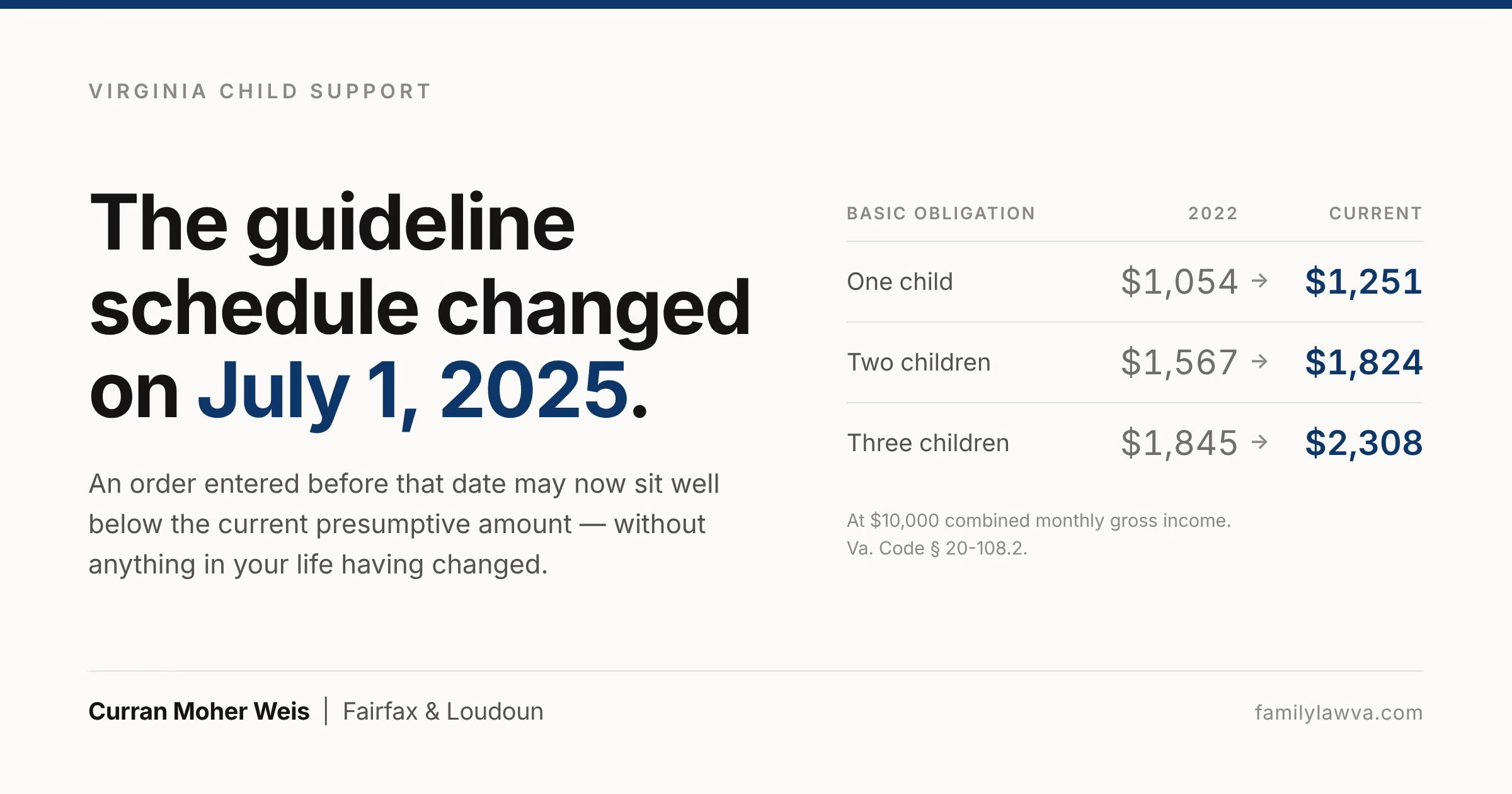
Virginia's child support schedule changed on July 1, 2025. If your order predates it, you may be able to seek a modification without proving a life change.
This topic is part of Child Support in Fairfax and Loudoun.
Child support modification in Virginia normally turns on a question most parents already understand. What changed? Someone lost a job. Someone got a promotion, or a bonus structure, or a second child in daycare. That is the ordinary route, and it is the one Va. Code § 20-108 contemplates.
There is a second route, and it has sat unused in a great many Northern Virginia files since July 1, 2025. On that date a revision to the child support schedule took effect, enacted as Chapter 702 of the 2025 Acts of Assembly out of Senate Bill 805. It rewrote the tabulated basic support obligations in Va. Code § 20-108.2. If your order predates it, the figure in that order may now sit a long way from what the current guidelines produce on the very same incomes. That gap alone can be enough to get you into court.
What actually changed in the guidelines on July 1, 2025?
Two things, and the commentary has tended to emphasize the less important one.
The first is the threshold. The schedule stops tabulating at a stated level of combined monthly gross income, and above it the calculation shifts to a marginal percentage of the excess. That threshold moved from $35,000 to $42,500. The percentages, 2.6 percent for one child rising through 5.0 percent for six, did not move. This is the change that drew the “high-income families” headlines.
The second reaches ordinary Fairfax and Loudoun households: the tabulated amounts inside the schedule were revised upward. Run the comparison at $10,000 in combined monthly gross income, which in this part of Virginia is not a high-income case, and the shift is substantial. One child goes from $1,054 to $1,251. Two children, from $1,567 to $1,824. Three children, from $1,845 to $2,308.
A caution. Those are the $10,000 line and nothing else. The shift at other income levels is not the same percentage, and the arithmetic of a guideline calculation is unforgiving. Run the numbers at the incomes in your own case.
Do I have to prove a material change in circumstances?
Ordinarily, yes. Edwards v. Lowry, 232 Va. 110, 348 S.E.2d 259 (1986): the party seeking a change bears the burden of proving a material change in circumstances justifying modification. A parent seeking a reduction carries more, and must make a full and clear disclosure of his ability to pay.
But the guideline amendment opens a separate door. In Slonka v. Pennline, 17 Va. App. 662, 440 S.E.2d 423 (1994), the Court of Appeals held that a substantive change to the statutory support guideline scheme, combined with an earlier award that varies significantly from the presumptively correct guideline amount, provides sufficient justification for a modification hearing. No separate proof of changed circumstances was required.
A precision point worth getting right, because opposing counsel will correct it if you do not. The amendment is not itself a material change. Head v. Head, 24 Va. App. 166, 480 S.E.2d 780 (1997), called that characterization technically incorrect while still allowing the motion to be heard. It is an exception to the material-change requirement, not an example of one.
How big does the gap have to be?
Significant. That word is doing real work and no fixed percentage attaches to it. In Head, a variance of roughly fifty percent qualified.
The method matters more than the label. Head holds income constant at the figure found at the prior hearing and recalculates under the amended schedule. Same income, both versions of the table. And the burden sits on the party asking for the change, who has to show both that the revision was substantive and that it produced a significant difference on these incomes. The existence of the 2025 amendment is not an argument. The worksheet is.
One honest flag. The other side has a reading available: that the variance must be attributable to the amendment rather than to a prior agreed departure. Slonka’s own facts cut against it, because the award there was an agreed figure and the Court measured the gap against the award as it stood. Our position is that the test is the actual variance, whatever produced it. Understand that as a reading, not a settled rule.
What if our child support number came from a signed agreement?
This comes up constantly with high-asset and business-owner clients, where support was one term in a much larger deal involving the house, the business interest, and the equitable distribution of retirement accounts.
An agreement does not close the door. Slonka arose from exactly that situation. But the agreement is still worth a great deal, just at a different stage.
In Shoup v. Shoup, 37 Va. App. 240, 556 S.E.2d 783 (2001), sitting en banc, the Court of Appeals identified only three limitations on the parents’ right to contract about child support, and held that neither the Code nor Virginia case law imposes additional restrictions. Watkinson v. Henley, 13 Va. App. 151, 409 S.E.2d 470 (1991), goes further in the agreement’s favor: where parents have agreed on an amount, the trial court must consider the provisions of that agreement in deciding whether the presumptive amount would be unjust or inappropriate. Must, not may.
What parents cannot do is contract away the child’s right to support or strip the court of jurisdiction. Kelley v. Kelley, 248 Va. 295, 449 S.E.2d 55 (1994). That holding is narrower than opposing counsel usually suggests.
So the structure is this. The amendment gets you the hearing. The agreement is defended at the hearing, on the deviation factors in Va. Code § 20-108.1. Losing the first fight does not lose the second.
When would a new amount take effect?
Not retroactively. Section 20-108 permits modification only for a period during which a petition is pending, and only from the date notice of that petition was given to the responding party.
The operative date is the notice date, not the filing date. It is a fact to be proved, from the return of service, and parents routinely assume the two are the same. Every week between filing and service is a week at the old number.
If you are the paying parent, read this part twice
Once the threshold for review is crossed, the court recalculates the presumptive amount from scratch. Barnhill v. Brooks, 15 Va. App. 696, 427 S.E.2d 209 (1993). The prior award is not the starting point and not a floor. Richardson v. Richardson, 12 Va. App. 18, 401 S.E.2d 894 (1991), puts it from the other side: a permissible variation is calculated from the presumptive figure in the schedule, not from a previously determined award.
One limit cuts against reopening. If the complaint is simply that the judge who entered the old order never made the written findings a deviation requires, Barnhill forecloses using that, standing alone, as a basis for trial-level review now.
None of this runs in one direction. A payor whose guideline figure under the current schedule comes out lower on today’s incomes has the same route. Adjacent questions keep their own standards and should not be folded into the motion without thought: spousal support, imputation of income after a job loss, and the federal pension issues in military and federal-employee divorce.
Where the motion goes in Fairfax and Loudoun
The motion belongs in the court with continuing jurisdiction over the support order: the juvenile and domestic relations district court where the order was entered there, the circuit court where support was set in a divorce. If custody and visitation are also in play, that posture may affect where the matter is best heard, and modification and enforcement practice is not identical across the two forums.
Scheduling practice differs between Fairfax and Loudoun, and each circuit’s local rules are worth checking before noticing anything. What does not differ is what the judge wants in hand: two worksheets, the same incomes in both, and the order being challenged.
Frequently Asked Questions
Can I get child support modified in Virginia without proving a change in my circumstances?
Possibly, if your order predates July 1, 2025. Virginia case law permits a modification hearing where a substantive change to the guideline scheme is combined with an earlier award that varies significantly from the current presumptive amount. You still have to show the variance.
How do I know whether my old order varies significantly from the new guidelines?
Recalculate using the same incomes the court found at the prior hearing, once under the schedule in effect then and once under the current schedule. No fixed percentage qualifies as significant. The comparison is the evidence.
Our child support amount was in our property settlement agreement. Does that block a modification?
No. Parents may agree on an amount, and Virginia courts must consider that agreement, but parents cannot contract away a child’s right to support or prevent a court from modifying its own decree. The agreement is an argument at the hearing, not a bar to it.
If I file now, how far back can the new amount reach?
Not before the date the other parent received notice of the petition. Virginia does not permit retroactive modification of support, so the service date sets the earliest effective date.
Child support cases turn on the specific incomes, custodial schedule, and order language in front of the court, and nothing here predicts any particular result. If your order predates July 1, 2025, the first step is to run the comparison and see whether there is anything to this at all.
Practice Areas
Custody & Visitation · Spousal Support · High Net Worth Divorce · Executive & Government Contractor Divorce · Child Support Calculator · All practice areas
This article provides general information about Virginia law and is not legal advice. Reading it does not create an attorney-client relationship. The application of the law depends on the specific facts of each case.